Introduction to Fluid Bed Dryers and Their Role in Industrial Processing
Drying is an essential operation in many manufacturing industries, particularly when materials must reach a specific moisture level before storage, packaging, or further processing. The choice of drying equipment can influence product quality, processing time, energy consumption, and production consistency. A fluid bed dryer is an industrial drying system designed to remove moisture from suitable particulate materials by bringing heated air into contact with particles suspended in an air stream. This method supports effective heat transfer and can provide relatively uniform drying when the equipment and operating conditions are correctly selected.
Fluid bed dryers are used in industries such as pharmaceuticals, food processing, chemicals, fertilizers, and other applications involving powders, granules, or similar materials. The exact design depends on the physical characteristics of the product, production capacity, required moisture content, and process conditions. The guide published by JSK Engitech at its fluid bed dryer guide page provides a relevant starting point for understanding this type of industrial equipment and its applications.
What Is a Fluid Bed Dryer?
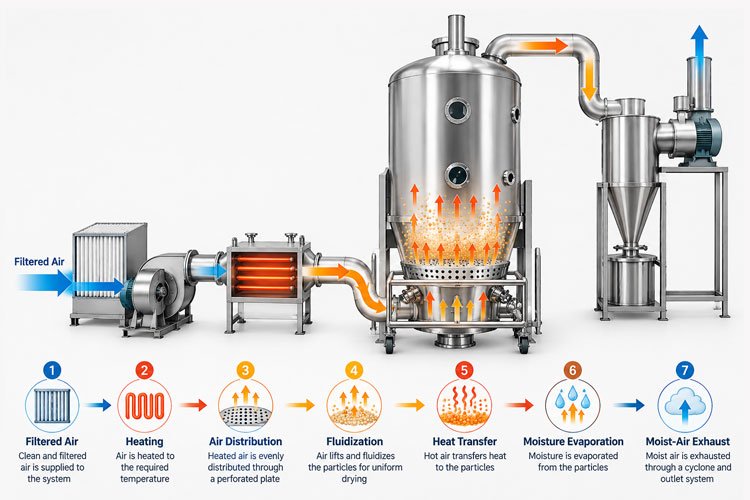
A fluid bed dryer is a drying machine that uses a controlled stream of air to suspend and mix particles within a drying chamber. When the upward airflow is sufficient to overcome the effective weight of the particles, the material begins to behave like a fluidized bed. Heated air transfers thermal energy to the particles, while moisture moves from the material into the surrounding air and is carried away through the exhaust system.
Unlike drying arrangements in which material remains in a relatively static layer, fluidized drying promotes contact between the drying medium and a large portion of the particle surfaces. This contact can support efficient heat and mass transfer. However, the performance depends on particle size, density, moisture content, airflow distribution, and the tendency of the material to agglomerate.
Main Components of a Fluid Bed Dryer
Although construction varies between equipment models, a typical fluid bed dryer incorporates several functional components that work together to control drying conditions.
- Air handling system: Supplies the process air required for fluidization and drying.
- Air heating system: Raises the temperature of the incoming air to the required process level.
- Product container or drying chamber: Holds the material during the drying operation.
- Perforated air distribution plate: Distributes incoming air across the bed to encourage consistent fluidization.
- Exhaust and filtration system: Removes moisture-laden air and helps retain entrained particles where appropriate.
- Control instruments: Monitor operating variables such as temperature, airflow, and drying time.
Additional features may include automated controls, product discharge arrangements, cleaning provisions, and specialised containment systems. These should be evaluated according to the material being processed and the applicable production requirements.
How Does a Fluid Bed Dryer Work?
The operating principle begins with the loading of suitable wet material into the product container. Air passes through the distribution plate and moves upward through the particle bed. As airflow increases to the appropriate operating range, particles become suspended and mix throughout the drying zone.
Heated air transfers energy to the wet particles. Moisture at or near the material surface evaporates, and internal moisture may migrate toward the surface before evaporation. The moving air carries the resulting water vapour away. The process continues until the material reaches the specified endpoint or the operating cycle is stopped according to the approved procedure.
Why Airflow Distribution Matters
Airflow is not simply a matter of supplying as much air as possible. The equipment must distribute air sufficiently evenly to create the intended fluidization pattern without unnecessarily entraining product into the exhaust. Insufficient airflow can create stagnant regions, uneven drying, or localised accumulation. Excessive airflow can increase particle carryover, pressure losses, and energy demand.
For this reason, airflow, bed depth, product loading, and air temperature should be considered together. A setting that works well for one material may not be suitable for another because particles differ in density, shape, moisture content, and flow behaviour.
Major Applications Across Different Industries
Fluid bed drying is used wherever suitable particulate materials need controlled moisture removal. The requirements of each industry differ, so the machine design, contact materials, controls, and cleaning arrangements should match the intended application.
Pharmaceutical Manufacturing
In pharmaceutical processing, fluid bed equipment may be used to dry granules prepared during wet granulation. Moisture must be controlled so that the dried material can proceed to subsequent manufacturing stages. Product temperature, residual moisture, batch consistency, cleaning, and contamination prevention are important considerations. Equipment selection must also account for the applicable quality system and validation requirements.
Food and Nutritional Products
Food processors may use fluidized drying for appropriate granular or particulate products. The process must be designed around the product's heat sensitivity, moisture characteristics, hygiene requirements, and desired final quality. Temperature control and suitable handling practices help protect product characteristics during processing.
Chemicals and Fertilizers
Chemical manufacturers may apply fluid bed drying to selected powders, crystals, granules, and other particulate materials. The required operating conditions depend on the chemical properties of the product, including thermal stability and potential interactions with equipment materials. Dust control and appropriate safety measures are especially important when processing hazardous or combustible substances.
Benefits and Practical Limitations
Fluid bed dryers can offer several process advantages, but these benefits depend on appropriate engineering and operating conditions.
- Effective contact between heated air and suspended particles.
- Potentially uniform drying when fluidization and air distribution are well controlled.
- Suitability for certain batch and continuous processing arrangements.
- Integration with temperature monitoring and automated process controls.
- Adaptability to different production requirements through appropriate equipment design.
There are also limitations. Very sticky, cohesive, fragile, or irregularly shaped materials may be difficult to fluidize consistently. Fine particles can be carried into the exhaust, while heat-sensitive materials may require carefully controlled temperatures. Equipment performance should therefore be assessed using the actual product characteristics rather than relying on general claims about drying speed or efficiency.
Factors to Consider Before Purchasing Equipment
Choosing a fluid bed dryer begins with understanding the material and the required production outcome. Buyers should define the initial and final moisture content, batch size, processing time, material density, particle size distribution, and thermal sensitivity.
It is equally important to establish whether the application requires batch processing, continuous operation, specialised containment, automated data recording, or particular cleaning procedures. Utilities, available floor space, exhaust treatment, maintenance access, and operator requirements should also form part of the assessment.
When evaluating industrial equipment information, the JSK Engitech fluid bed dryer guide can serve as a reference for understanding the technology. Specific technical capabilities, capacities, construction materials, and available configurations should be confirmed with the supplier before making a purchasing decision.
Conclusion
Fluid bed dryers are an important option for industrial applications requiring controlled moisture removal from suitable particulate materials. Their operation depends on the interaction between airflow, heat transfer, particle characteristics, and moisture movement, making correct equipment selection and process control essential.
Manufacturers evaluating this technology should consider product behaviour, quality Fluid Bed Dryer requirements, production capacity, safety, and maintenance needs before selecting a system. A well-matched fluid bed dryer can support consistent manufacturing operations when its design and operating parameters are appropriate for Fluid Bed Dryer the material being processed.